Sewage Backup Cleanup in Mesa AZ: A Homeowner's Guide
What to do when a drain or toilet backs up into your home, what not to touch, and how sewage cleanup, drying, and repairs fit together for Mesa and East Valley homes.
Few things stop a household in its tracks like dirty water bubbling up from a floor drain, shower, or toilet. If you are facing sewage backup cleanup in Mesa AZ, your first instinct might be to grab a mop and some bleach and get it over with. We get it. But sewage is not like a leaky supply line. It can carry bacteria and other contaminants, and how it gets handled in the first few hours affects both your family's safety and how much of your home can be saved. Here is what to do, what to avoid, and what professional cleanup actually involves.
First Steps When Sewage Backs Up Into Your Home
Start by keeping people and pets away from the affected area. Kids and dogs are naturally curious, and contaminated water is not something you want tracked through the rest of the house. Then work through a few quick steps:
- Stop using water in the home. Every flush, shower, or load of laundry can send more water back up the line.
- Stay out of standing water near outlets, cords, or appliances. If you can reach the breaker panel without walking through water, shut off power to the affected area. If not, leave it alone.
- Avoid running the HVAC system if water has reached returns, ductwork, or the air handler, so contaminants are not pulled through the house.
- Take photos and video of the water, the source if you can see it, and any damaged belongings before anything gets moved.
- Open a window if it is safe to do so, and close interior doors to help keep odors and moisture contained.
Why Sewage Is Treated Differently Than Clean Water
Restoration pros group water losses into categories. Water from a burst supply line usually starts as Category 1, or clean water. A sewage backup is Category 3, which is the most contaminated type of water damage. That classification changes nearly everything about the job.
Porous Materials Often Need to Go
Carpet, carpet pad, the lower portion of drywall, insulation, and particleboard cabinet bases soak up contaminated water and are very hard to clean all the way through. In most sewage losses, those materials are removed rather than dried in place. Hard surfaces like tile, sealed concrete, and framing can usually be cleaned and treated.
Bleach and a Mop Are Not Enough
Wiping up what you can see leaves contamination behind in baseboards, wall cavities, and under flooring. Mixing household cleaners can also create harmful fumes. Professional crews use protective equipment, containment, and cleaning methods suited to Category 3 water, then confirm the area is clean before drying and rebuilding.
What Professional Sewage Backup Cleanup in Mesa AZ Looks Like
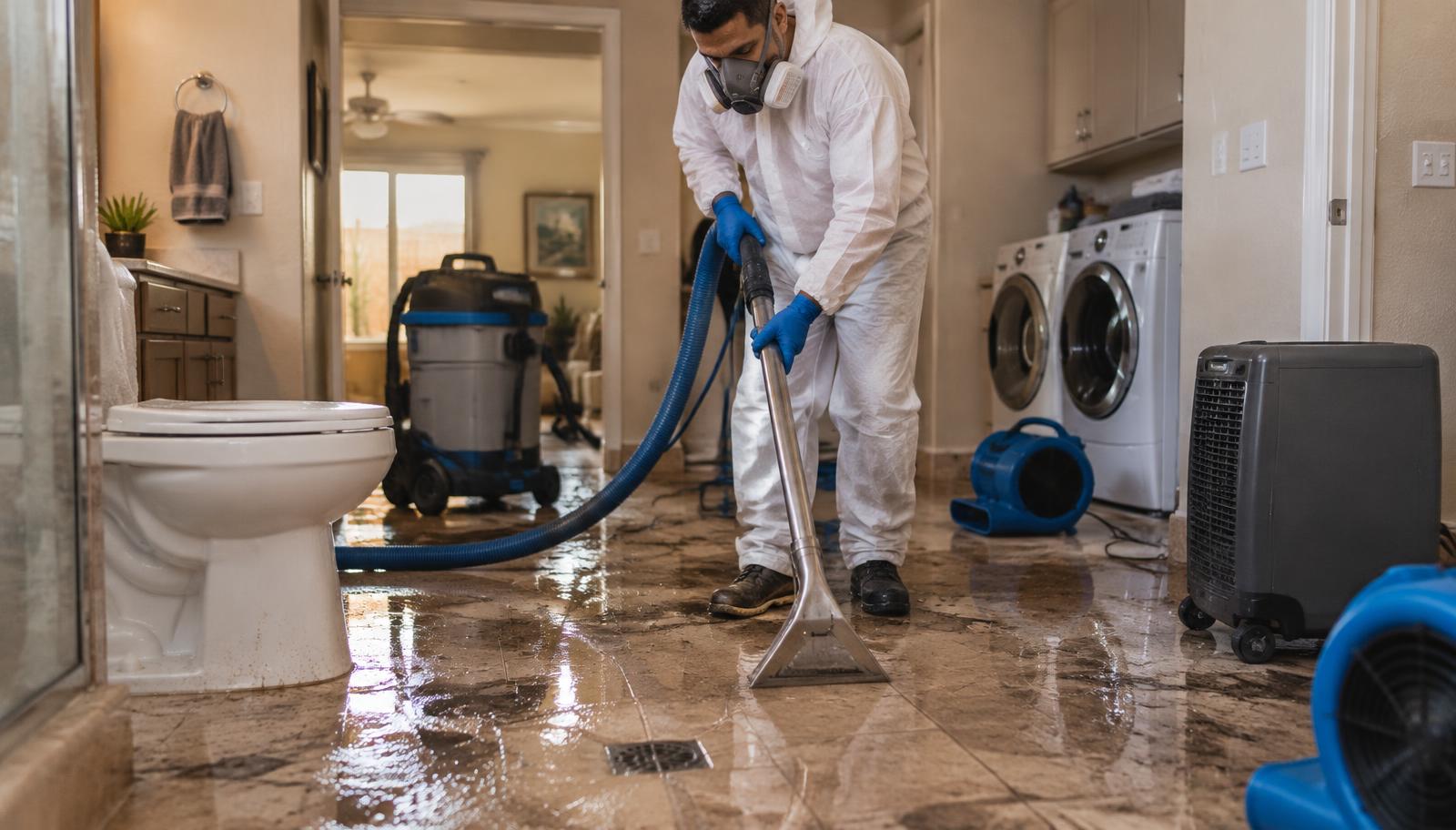
Every home is different, but a typical sewage cleanup follows a clear order. It usually starts with emergency water extraction to remove standing water and solids. Next comes careful removal of contaminated porous materials, followed by cleaning and treating the remaining surfaces. Once the area is clean, moisture detection tools map where water traveled, and structural drying and dehumidification equipment brings materials back to a dry standard.
This is the same core process used for any water damage restoration in Mesa, with extra steps for contamination. It is also where many homeowners first learn how far water can travel. Our guide on burst pipe water damage in Mesa AZ explains how water hides behind walls and under cabinets, and the same paths apply to a backup.
Drying matters here, too. Even in our dry Arizona climate, wall cavities and subfloors can stay damp long after the room feels dry, and damp materials are where mold often gets started. If a slow drain problem went on for a while before the backup, there could already be growth hiding behind finishes. Our article on hidden mold damage after a leak covers the warning signs, and if growth turns up, professional mold remediation should be planned alongside the cleanup. For more on that connected approach, see mold remediation and moisture control.
A Few Words About Insurance
Coverage for sewage backups varies by policy. Many standard homeowners policies limit or exclude damage from sewer or drain backups unless you have added a specific endorsement, and mold is often limited or excluded as well. Read your policy, call your agent or carrier to report the loss, and ask what they need from you.
Documentation helps either way. Rapid Restoration provides detailed photo documentation and moisture readings, and the team can walk you through the claim process. Your carrier makes the final decision on what is covered.
Repairs and Getting Your Home Back
Once everything is clean and dry, rebuilding can begin. That may mean new drywall, insulation, baseboards, flooring, or cabinets. Rapid Restoration & Construction offers full reconstruction services, along with content pack-out and restoration for belongings that need to be moved out while work is underway. If your home has been through other kinds of damage, the team also handles fire and smoke damage restoration, including the soot and odor issues described in where smoke damage hides after a house fire and smoke damage cleanup after a house fire.
For a broader checklist that applies to any water loss, read what to do after water damage in your Mesa home, or browse the full restoration blog for more guides for East Valley homeowners.
Sewage Backup FAQs
Can I clean up a small sewage backup myself?
A very small overflow on a hard, sealed surface may be manageable with gloves, eye protection, and proper disinfecting. Once sewage reaches carpet, drywall, cabinets, or more than one room, professional cleanup helps make sure contaminated materials are handled safely and hidden areas are not missed.
Who fixes the clogged or broken sewer line?
A licensed plumber should clear or repair the line itself. Restoration focuses on removing the water, cleaning and sanitizing affected areas, drying the structure, and repairing damaged building materials.
Can we stay home during sewage cleanup?
Sometimes. If the affected area can be closed off and contained, many families stay put. Larger backups, or homes with young children or anyone with health concerns, may make it more comfortable to stay elsewhere for a while.
Do you serve areas outside Mesa?
Yes. Rapid Restoration & Construction is based in Mesa and serves Gilbert, Chandler, Tempe, Scottsdale, Apache Junction, and surrounding East Valley communities.
Sewage Backup? Call Rapid Restoration 24/7
If sewage has backed up into your Mesa, Gilbert, or Chandler home, keep everyone out of the area, stop using water, and call Rapid Restoration & Construction. A live person answers 24/7, and the team can start with extraction, safe cleanup, and a drying plan for your home.
Call (480) 662-8146